![[Jcount.com]](https://www.jcount.com/wp-content/uploads/2014/08/jcount150X50.png)
![[Jcount.com]](https://www.jcount.com/wp-content/uploads/2014/08/jcountstartupslogo1.png)


If you run a small business with a local client base, you might not think you need to bother with a website, and you wouldn’t be alone. A recent survey from domain hosts, GoDaddy, found almost two-thirds (60%) of small businesses don’t have an online presence.
If this sounds like you, it’s time to bring your marketing strategy up to speed.
And if you already have a website, don’t think you can now sit back and relax – you need to make sure it’s fully optimised, if not for global search then certainly for local search.
What is website optimisation?
Website optimisation, or search engine optimisation (SEO), is simply a set of best practices designed to ensure your website has the best chance of ranking as highly as possible on the search engine results pages (SERPs) of engines like Bing, Google, and Yahoo.
What is local website optimisation?
Local website optimisation, or local SEO, is simply the optimisation process for the local results in search engines and app like Google Maps, and encompasses three main factors:
- Local Listings and Citations
- Online Reviews
- On-Site Local SEO optimisation
The reason why local SEO is so important is that, far from flicking through the Yellow Pages or local phone directory, most consumers now look online to find local shops and services, and many of them do so on a mobile device.
Making sure your website is optimised for use on mobile devices will not only help it climb the SERPs, it’ll also make for a better customer experience – if your website is difficult to navigate on a mobile, customers will simply look for another site that’s easier to use.
Once your site is mobile-ready, it’s time to get it optimised for local search.
Get listed
Modern consumers are overwhelmed with choices – simply begin typing a few words into a search engine and a mind-boggling number of options are returned, and you need to make sure your business is near the top of the list.
So write yourself a listing (just on a Word document / text editor to begin with).
State the name, nature, and opening hours of your business, as well as your company address and phone number.
For example:
Collister & Glover
Gas Piping and Plumbing
Tenth Avenue Zone Three Deeside Ind. Estate Deeside CH5 2UA
Opening Hours
Monday – Friday: 7am – 5pm
Telephone Number
01244 288000
Web Address
https://www.colglo.co.uk/
This will be required to create “NAP citations” across high quality directories, websites and search engines. “NAP” stands for Name, Address and Phone number, and these should be consistent across all listings where possible.
In order to qualify for a listing, your business must meet the following criteria:
- Have a business name
- Have a local phone number that matches your city of location
- Have a dedicated physical street address
- Make face-to-face contact with customers
Once you have your listing, get it added to as many local online listings pages as you can, making sure you include these big hitters:
- Google Business
- Yelp
- Bing Places
- Yellow Pages
- Yahoo Local
- Foursquare
- Freeindex
In short, the more business listings you feature in, the more likely this data is to be trusted and served up by a search engine.
Start with your listing on Google Business pages, and get verified – usually done via the post. This is the foundation of your local online campaign.
Get reviewed
Online reviews are becoming increasingly important.
Not only do they add regular content to your website – a great way to climb the SERPs – they also provide customers with much-needed insight into how well your business delivers on its promises.
They also provide a way to interact with customers beyond the transaction stage and respond to any criticism or thank people for their custom.
There are three main ways to go about getting customer reviews:
- Ask for a review at the point of sale
- Email customers asking for a review
- Leave a call to action on your website
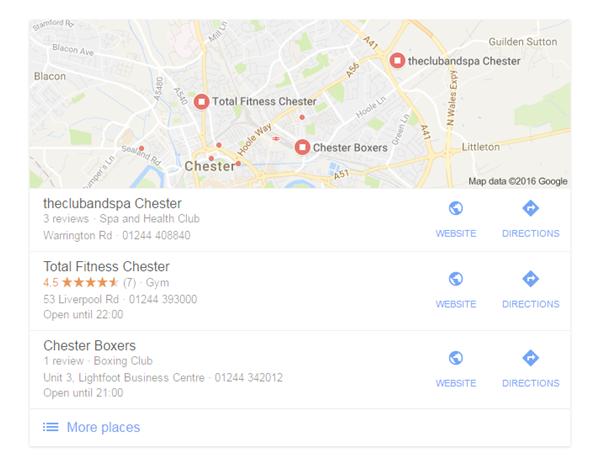
If you can get 5 reviews on your Google Business page, you should see the ‘star-ratings’ on your listing and it will greatly increase your chances of appearing in the ‘local pack’:
Get Optimised
The first step of optimising your website is to have your business name, address and phone number on each page – if you work across multiple locations, maybe place your primary location on each page and have the details of other sites on a ‘contact us’ page.
You’ll then need to make sure your site contains the keywords relevant to your business – so if you have a coffee shop in Liverpool city centre, you’ll not only want to make sure the keyword ‘coffee shop’ is present on every page, you’ll need to have ‘Liverpool’ and ‘city centre’ in there too.
These keywords need to occur naturally in the text and, if possible, should appear in the following places:
- Your URL
- Page Titles
- Meta Descriptions
- H1 and H2 Tags
- Sparingly throughout your site content
Also consider creating and updating a blog on your website, preferably with relevant local content.
Finally – you should definitely be complementing your website and optimisation efforts with effective use of social media. Start off by completing a Facebook and Twitter page. Consider running a very precise Facebook advert to drum up awareness of your business, and follow a number of local organisations and people on Twitter to get things started. Share useful information (and if PR allows, funny updates) if possible, rather than continually promoting your business offers and trying to directly generate sales.
And once all that’s in order you’re ready to welcome in all the extra custom an online presence will bring.


